Wednesday, May 28, 2014

Curses in Late Antiquity

Whether we know it or not, most religions have a dark side to them. More than just the current American mentality of “Islam is bad,” religions of all kinds have usually had some history with practices in some sort of magic, and Christianity is no exception. Regardless of whether these practices have yielded actual results or not, the intentions behind them are enough to warrant skepticism. The age old practice of cursing may have recently been made synonymous (almost exclusively so) with profanity, but there was once a time when the term referred to more than just the spouting of obscenities. By examining the history of Christianity, as well as some of these Christian curses (particularly those dating back to the late antiquity), we will see that even the most widespread of religions can have questionable backgrounds.

Since its emergence from the shadow of Judaism in the time of ancient Rome, Christianity referred to itself as a universal religion, though definitely less universally accepting and more seeking universal acceptance. Eventually, their need for acceptance would push the city of Rome to begin widespread persecution of Christians, ultimately ceasing with the issuing of the Edict of Milan in 313 AD, bringing about the legalization of Christianity. With this victory, Christianity began to spread even further than ever before.

      | Spread of Christianity to 325 AD
      | Spread of Christianity to 600 AD

Unfortunately, there will always be those who refuse to join the cause, which brings us to the curses. From turning men “tongue-tied” to bringing seventy different diseases upon a person, the range of curses the Christians had access to is staggering. For a religion which advertised itself as “universal,” it certainly had a wide variety of ways to bring harm to people (in theory).


In conclusion, while we may perceive Christianity today as a harmless, widely accepted religion, it should be remembered that it has had a somewhat dark past. The horrors that some people would wish upon their fellow man for something as simple as a disagreement of religious beliefs are almost unspeakable. Thankfully, it seems as though our more scientific mentality of the present has allowed us to leave such practices behind.

Bibliography:
Hornblower, Simon, and Antony Spawforth. The Oxford Companion to Classical Civilization. Oxford: Oxford UP, 2004. Print.
Ward, Allen M., Fritz M. Heichelheim, and Cedric A. Yeo. A History of the Roman People. 4th ed. Upper Saddle River: Prentice Hall, 2003. Print.
Meyer, Marvin W., and Richard Smith. Ancient Christian Magic: Coptic Texts of Ritual Power. Princeton: Princeton UP, 1999. Print.

Battle of Masada

The war of Masada and Titus, also known as the Great Revolt, was not a war about anything in particular for the Romans so much as just another war with no real significance other than to crush a rebellion. For the Jews however, the same did not hold true. This was a war over terrible conditions due to terrible leadership in Israel. For so many years, the Jews had paid their taxes, obeyed the laws of the government and had tried to do their best to be good citizens of the Roman Empire. The revolt was sparked because of a succession of terrible senatorial leaders in Israel and many internal crises as a result of that poor leadership and because the government of Rome did not help them despite the repeated pleas for aid from the Jews. It really did not help that the Jews were subject to unreasonable taxes where, if more money was collected than was the required amount, the tax collectors were able to keep the extra tax money, but nor did it make the tensions between the Roman Empire any less when Emperor Caligula threatened to destroy the Temple because the Jews said no to the Emperor’s proclamation that there be a statue of himself put inside every temple throughout the empire. They adamantly refused on the grounds that by doing so, they would be defiling their place of worship, because they would be placing a pagan statue in their holiest of places. Therefore, they decided to rebel because of all the unfair conditions and the fear of another emperor who would threaten them similarly, but actually follow through on those threats. The revolt was actually due mainly to Jewish radical groups. Two years after the beginning of the revolt, those radicals marched onto Jerusalem and killed all of the members of the government who were not radicals like themselves. The final major fight was on Masada, the sight of the once Roman fort which was then captured a number of years later by the Jews, towering 1700 feet above the Dead Sea. There atop Masada, the last of the Jewish rebels stood, mostly being the radical that originally instigated the revolt along with their families, holding up their defenses against the seemingly endless onslaught of Roman soldiers. Eventually, the Romans built a long ramp that reached all the way to the top of Masada and from there, they were able to capture the last major Jewish stronghold (there were still pockets of rebellion throughout the empire for several years afterward). However, as soon as the Romans reached the top of Masada, the Jews immediately set fire to everything and then almost all of the Jews swore a suicide pact, drew straws, and after one Jew had killed the others, he killed himself, leaving two women and five children to be captured by the Romans. These women, along with the children, would either be put to death or sold into slavery after being captured. Thus the Great Revolt of the Jews, which lasted for four years, ended in failure and instead of resulting in better conditions for the Jews of Israel, brought about the dispersal of the majority of the Jews from Israel for the next two thousand years, until 1948 when Israel was reestablished as the Jewish homeland.


Resources:
A History of the Roman People by Allen Ward, Fritz Heichelheim, and Cedric Yeo
History of Rome by Michael Grant
http://www.jewishvirtuallibrary.org/jsource/Judaism/revolt.html

Tuesday, May 27, 2014

Ancient Philosophy

How Ancient Philosophy has Influenced the Modern World

Philosophy is one of the many major influences on the modern world and the way our

world’s history has progressed. Throughout time since Ancient Greece, Greek philosophers have

created many principles that are still relevant today. Some of these philosophers, whose names

are renowned by many, like Socrates, Plato, and Aristotle, have influenced the world greater than

the “modern thinkers” of our time.

For starters, philosophy has greatly influenced and changed the ideas people have on

forms of education and the role of the student and the role of the teacher. This was an idea that

was established by ancient philosophers, showing their beliefs on what position the student

should take on the gaining of knowledge. Before, students were regarded as tools, mindless and

ignorant, and were all taught the same ways by their private tutors. But in the modern age,

students are all taught differently in a way that they can gain relevant knowledge pertaining to

bettering themselves.

Not just the educational world was influenced by ancient philosophy. What most don’t

realize is that the political world was also influenced, as well as art and religion. But starting

with politics, the ideas of Ancient Greek philosophers were not taken too as well as they would

have hoped. To start, a main belief of philosophers is that people should be ruled by a

“philosopher king.” While this doesn’t directly pertain to the ancient philosophers, it was a

generally agreed upon topic between philosophers, although it was more common in the

Enlightenment Age. In modern times, philosophers are not as well regarded as they were in the

past. But the effect that these ideas had on modern politics is that philosophers based political

arguments on basic principles such as humanism and freedom of the people.

Another topic that philosophy has influenced in a major way is religion. Many religions,

such as Islam, were affected by the ideas of ancient philosophy. But the religion that was greatly

affected by ancient philosophy is Christianity, which was a religion that sprouted up around the

same time as these ancient philosophers. In Christianity, the New Testament was even based on

Greek Philosophies. Because of the New Testament being based on Greek philosophy, the

influence of these philosophical ideas have been a central idea in the religion of Christianity.

Lastly, while philosophy was regarded in a higher manner during ancient times, its

influence on our modern world has greatly shaped our ideas on education, politics, and most of

all, religion. These ancient influences on modern life show just how important and relevant

ancient philosophy is.


Works Cited Page

http://www.iep.utm.edu/greekphi/

https://www.google.com/imghp?

hl=en&tab=wi&ei=HX5_U6_hC4vMsQSCw4KIBw&ved=0CAQQqi4oAg

Hypatia and the Persecution of the Pagans

Hypatia was born 350 AD, Egypt. She was the daughter of Theon, who was considered

to be a well-known and respected philosopher and scientist throughout Egypt. Some historians

believe that Theon wanted to raise the perfect human. It is apparent that she had developed a

passion for mathematics and sciences. Most historians are certain that Hypatia surpassed Theon’s

knowledge at a young age. Her father also taught her the fundamentals of teaching so that she

became a very enticing orator.

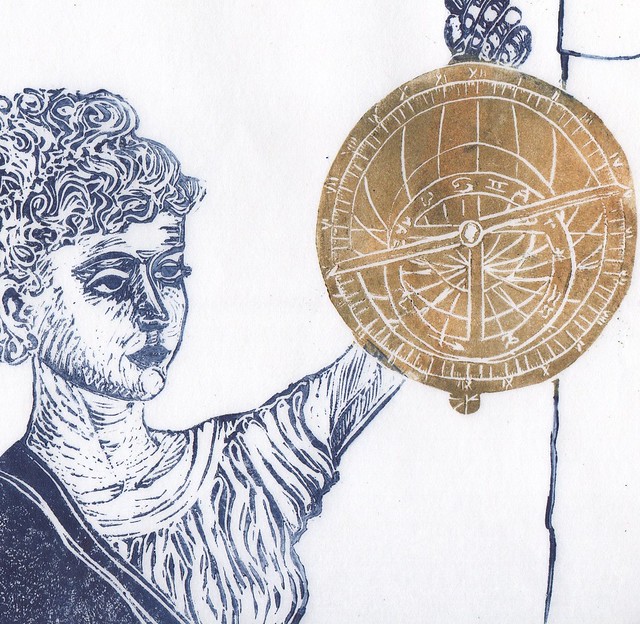
Hypatia studied astrology, astronomy and mathematics. She was later credited by her

students of inventing the astrolabe. However this is very unlikely because the astrolabe was

dated a few centuries earlier. Historians believe she merely promoted the astrolabe’s use. In

addition, she studied conic sections, which were introduced by Apollonius. She wrote a book

called On the Conics of Apollonius. She was credited introducing ideas of ellipses, hyperbolas,

and parabolas.

 Hypatia with Astrolabe (the astrolabe

was used by astronomers, navigators, and astrologers, to find the time, place, and

positions of constellations in the sky)


At the end of the antique period, Christianity was starting to dominate the roman religion.

Riots frequently broke out between the different religious sects. Two leaders were opposing

each other, Cyril and Orestes. Hypatia, who happened to be a good friend of Orestes, was

unfortunately involved. Cyril spread nasty rumors about her. In 415 AD, a violent mob attacked

Hypatia on her way home. They apparently stripped her and killed her with shards of pottery,

then dragged her through the streets.


At this time Hypatia was one of many persecuted by the Christians, because she was

pagan. The Christians persecuted the pagans persecuted as much as the pagans persecuted them.

However not all Christians did this. Some were ambivalent and did not care. This example shows

how the Christians behaved when the tables were turned on the pagans.


Hypatia was also known as a philosopher, but not as much as her work on conic sections


Bibliography:

http://www-groups.dcs.st-and.ac.uk/history/Mathematicians/Hypatia.html

http://www.agnesscott.edu/lriddle/women/hypatia.htm

http://www.astr.ua.edu/4000WS/HYPATIA.html

http://www.heretication.info/_pagans.html

Romanization of British Religion

Owen K-W
Latin 3
5/23/14
The Romanization of British Religion
When the Romans started moving into Britain, many aspects of ancient British culture were changed and merged into Roman culture as Britons became citizens or Rome. According to the British Museum, following the Roman religion was necessary to prove loyalty to Rome. However, the not all of the Britons necessarily wanted to convert to another religion. The Romans, to make the foreign religions easier to understand, associated certain British deities with their own, which as a side effect made it more simple for the British people to worship their own gods but still be loyal to Rome. An example of this is the town of Bath, there the goddess Sul was worshiped. According to AQUAE SULIS, Sul was the goddess of rivers and fertility, as well as being a mother goddess. When the Romans arrived at Bath, they associated Sul with Minerva because they were both thought to have healing powers. The British religion was greatly changed by the Romans, but it kept many significant traits, such as the importance of sources of water and the number three. There were several Romano-british trios of gods and goddesses, according Rhythms of Triplism: The Triple Figures of Romano-Celtic Sculpture. While the Romans generally had no problems with British religion, they had very serious conflicts with the druids, who the Romans were afraid would contest their leadership. Several laws were passed prohibiting their religious rituals, and emperor Augustus did not allow people to be both Roman citizens and druids at once.
As the Romans moved in to Britain, their culture became mixed with the culture of the British. Many British gods were similar enough to one of the Roman gods that the two were blended into one. Rome's religion was somewhat flexible, making it simpler for Rome to take over areas with different deities. However, when a religious group proved to be a threat, Rome did not hesitate to take it down.


Bibliography

http://www.unc.edu/celtic/catalogue/triplism/

Monday, May 26, 2014

Raphael Human Sacrifice


Raphael Kahn
Latin 3, Period 7
5/26/14
Roman Sacrificing
            Roman sacrifices were held so that Romans could repay the spirits that they had invoked. For instance, in order to repay Mother Earth for harvesting crops, the Romans held the annual spring festival of the Fordicidia. In this festival, they would kill a pregnant cow and make a burnt sacrifice of her aborted calf, in order to transfer the cow’s fertility to the earth. Sacrifices could also be used to symbolize the transfer of ownership. The typical sacrifice was performed through four phases: the praefatio, the immolatio, the slaughtering, and the banquet. In the praefatio, after the purification of the participants and victims, a procession led them to the altar of sacrificing. In the immolatio, wine was poured on the victim’s face and salted flour was sprinkled on the victims back. In the slaughtering, the victim was killed, butchered, and had its corpse opened up for the inspection of its vital organs. If the quality of the organs were deemed unsatisfactory, the sacrifice was held again. In the banquet, the victim was beheaded and the vital organs were set aside and prepared for offering. The method of preparation depended on what type of animal the victim was. After the vital organs were prepared, they were offered to the deity for whom the sacrifice had been conducted for. The manner of offering depended on which deity it was. For example, the offerings were thrown into the water for an aquatic deity. After the offerings were given to the deity, the rest if the victim was prepared for human consumption. While Romans were perfectly content to sacrifice all manner of creatures, fruits, vegetables, and even inanimate objects such as necklaces and bracelets, they abhorred human sacrifice. The Roman government did not tolerate human sacrifice, and by extension, did not tolerate Gaulish Druids. In Pliny the Elder’s writing, he denounces the nature of the Druids as barbaric for their belied in human sacrificing.
            While some people may have deemed the ancient Romans as barbaric for their conquering, slavery, and sacrificing, they did hold high standards for their time. They allowed more freedom of religion then was expected for their time period, they allowed slaves to earn their freedom, and they abhorred and outlawed human sacrificing. There is even a story about a man who, in order to please the gods, sacrificed his son. To do this, he killed his son, mutilated him, made him into a soup, and served it to the gods. Jupiter, finding this disgusting, sent the man to the underworld as punishment and reanimated the son. Yes, the ancient Romans had some questionable customs, but hey-at least they were not Druids.
 

Sources:


Sunday, May 25, 2014

Curses

During the start of the 1st Century A.D., there were Romans who had very unique ideas about how religion worked. They believed that people could pray to their gods, to improve their own lives, and to ruin others. Many people would wonder why others would want to cause others harm.
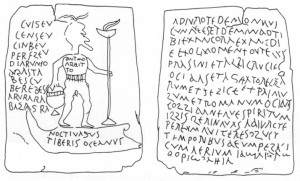
In recent years, archeologists have discovered several tablets where ancient Roman civilization used to dwell. Some of the tablets are made of lead, and others are made from pewter, with inscriptions carved into them, asking for a god to grant the writer's the suffering of another individual. These tablets, are called “defixiones,” or, “curse tablets.” A few hundred have been excavated in Britain alone, and approximately ninety have been dug up in the historic town of Aquae Sulis.
The procedure of creating a curse tablet could follow a couple of methods. The first step, was to identify the intended recipient of the tablet-maker's wrath, and then inscribe it on the tablet. If the owner did not know the name of the victim, than they'd write an inventory of potential names instead. The next step was to explain the crime committed against the tablet's creator. Finally, they would identify the deity they wanted to do the act, and provide a description of how to go about the punishment, which would usually be very detailed, and very gory. Upon completion, the tablet would be rolled up, and either attached to a tomb, or dropped down a well.
Sometimes the tablet might have been more elaborate than just mere words. Some people had an idea that if written backwards, the words of the curse would have greater effects. Another idea for augmenting the potency of the tablet involved nonsensical words that did not exist. These included, “bazarga; bescue; berebescue; phrix; phrox;” and even, “abracadabra.” Some even included illustrations depicting demons or other mythological figures. In today's society, there would be many people who would disagree with this belief, given that it shows such malice towards others.
It is fascinating that the Romans, “... tended to see their gods as possible allies in the struggles of life.” (Cambridge, Page 42). However, there are some people who would disagree with the way the Romans applied the boon of divine alliance to the expense of another person, there are others who would promote the belief of a higher power looking out for individuals happiness and well-being.

Bibliography:
Cambridge Latin III

Saturday, May 24, 2014

Persecution of Christianity

Persecution of Christianity

The Roman Empire is remembered today for its awesome power and many innovations, but one aspect of their remembrance has become a prominent discussion in our day and age, the prosecutions of Christianity. To an extent, Romans were understanding in others’ religions and cults. One of the major parameters they did set was that these groups had to pray to their gods. After Jerusalem was captured, Jews were treated harshly by the Romans, in part by their unwillingness to recognize Roman gods and the emperor as holy. There was tension on both sides but over time and integration between Jews and Romans, Jews were allowed to practice their religion without objection. Romans understood they were passionate about their belief in a singular god and could see the reasoning behind not preying to anyone else. However when Christianity came along, the Romans did not want to make another exception for a similar religion. After all, the Old testament for Christianity is the Torah for Judaism. In 64 C.E., Emperor Nero engineered the first attack on Christianity. He blamed the Great Fire, which some had thought he ordered, on those of Christian faith. During specific negative events or times of crisis, persecutions took place to take out the Romans’ anger and to use as a distraction. It was common for emperors to order persecutions to take the focuses off their negativity. These persecutions were accomplished in different ways. One of the most common methods was burning Christians alive, but there were other methods like putting Christians in a beast-fighting ring or feeding them to dogs. Throughout the first, second, and third centuries, persecutions severely depended on how the local governments approached Christianity. Often times persecuting Christians just became scapegoating for another issue. The fact that they were Christan were attacked making other important issues in less significant. On a broad point, Christians were prosecuted to discourage further conversions and bring people back to the belief in the Roman gods. This is how the last persecution of Christianity began. Galerius, the ruler of one of the four Roman provinces, convinced another named Diocletain to start persecuting in order to restore the purity in Roman religion that was severed by the introduction of Christianity. From the year 303 to 313, Christians had to swear an oath to the Roman gods and make an offering to them or die. During this time, churches were burnt, Christians were imprisoned, tortured, and murdered in one of the largest persecutions in Roman history. The persecutions of Christianity have extreme importance for they led, in part, to the rise of the Christianly. Although Christianity had already gained a following prior to the persecutions, the persecutions drew attention to the cause. If someone demands someone can not do something, the instinct reaction is to do exactly that. The Roman persecutions of Christianity had an drastic influence in the world we see today.


Works Cited
Websites:
http://www.fourthcentury.com/notwppages/persecution-timeline.htm ( Supported by History Department of Wisconsin Lutheran College and by Asia Lutheran Seminary)
http://www.britannica.com/EBchecked/topic/164042/Diocletian/1832/Persecution-of-Christians
Books:


Friday, May 23, 2014

Cult of Mithras

Zachary Emil
Ms. Hatmaker
Latin III/Period 7
5/21/2014
Cult of Mithras
The Cult of Mithras, otherwise known as Mithraism or the Sun religion, was a religion that most originated from Persian Zoroastrianism, but officially recognized as a cult by the Roman Empire. They worshiped Mithra, a god commonly associated with light or the sun, and a hero of lightness over darkness. Mithraism is often referred to as a "mystery cult," secrecy played a large role in the religion. No written texts from Mithraism exist, and rituals were practiced in temples, known as Mithraeum, disguised to look like natural caves. What is known of the mythology is from paintings and reliefs in these temples; two of the most common depict Mithras sacrificing a sacred bull, and Mithras being born from a rock. Sol, the personified god of the sun, is often depicted alongside Mithras. Those who joined Mithraism had to sacrifice a bull, and were baptized in its blood. There was also a class system: Corax, Nymphus, Miles, Leo, Perses, Heliodromus, and Pater. Those who gained the title of Pater, or father, were allowed to be head of the congregation. It was very popular among Roman soldiers, most likely because of Mithras reputation of a warrior for good, as well as those who weren't citizens of Rome, such as merchants. However, women could not join. Mithraism began to grow in power and in followers; at one point, there were several Roman senators were suspected to be part of the Cult of Mithras. Its eventual downfall is commonly attributed to the spread of Christianity after it was named the Roman Empires official religion by Constantine, as well as the fact that it restricted its followers more.
Bibliography:
A history of the Roman People, edited by Allen ward and fritz heichelheim and Cedric Yeo

The Battle of Milvian Bridge

During the fourth century Christianity was spreading across Rome, and it would eventually become the main religion of the empire. This might not have happened however if it wasn't for the emperor Constantine and The Battle of Milvian Bridge. This famous battle was fought between two men who both wanted to become the next emperor. They were Constantine and Maxentius. This war had started when the precious emperor, named Diocletian, had abdicated. Maxentius had previously won two battles in Italy and had occupied the city of Rome; while Constantine’s army waited outside. Rather than be sieged Maxentius went out to fight. The battle took place in front of a bridge over the Tiber called the Milvian Bridge. The two events that make this battle so important are first that Constantine won and became emperor, and second the vision that Constantine had just before the battle. Lactantius, one of Constantin’s advisers, wrote that the night before the battle Constantine had a dream where he was told to paint the sign of the cross on to his soldier’s shields. Constantine then saw the sign of the cross in the sky, and he had visions of Jesus. Constantine’s subsequent victory converted him, and later the rest of Rome, to Christianity. Later Constantine would pass the Edict of Milan and make Christianity the official religion of the empire. The roman adoption of Christianity has greatly changed the world. All of Europe would eventually change from Pagan to Christianity. If Constantine hadn't had those visions, and if he hadn't won the battle, world history would be very different. 

Thursday, February 3, 2011

Sources: 
http://www.agnesscott.edu/lriddle/women/hypatia.htm
http://penelope.uchicago.edu/~grout/encyclopaedia_romana/greece/paganism/hypatia.html

http://hypatia.ucsd.edu/~kl/hypatia.html

http://www-history.mcs.st-and.ac.uk/Biographies/Hypatia.html
www.wikipedia.org

and the pictures: 
Adina Samuels 
Mrs. Hatmaker 
Latin 3, 6th
2.03.2011

In Ancient Rome, there was a lot of turmoil between Greek pagans and Christians and in the rest of the empire. Once Christianity was finally in charge of Rome, the Christians started persecution, which had at one time been delivered to them. A few notable incidents of persecution delivered by Christians are the execution of Hypatia, Roman Emperors in forcing laws against Roman Paganism, and the results following the Edict of Thessalonica.
Hypatia was a Greek woman who lived in Roman Egypt between the years of 370 through 415. She was taught in the ways of speaking and holding an audience by her father Theon, in order to eventually gain an interest in math, science and astronomy. Through her research, she became a respected teacher and people came from great distances to hear her words. One night, Hypatia was walking in the streets of Alexandria, when a Christian mob killed her with pieces of pottery. After she was dead, her body was torn apart and burn. This was the first notable incident of Christian aggression to non believers. What may be a reason as to why Hypatia was executed, was because some of her teachings may have questioned the church's preaching. This is because pre modern Christianity believed in the earth being in the center of the universe, and in people living their life devoted to worshiping god. When a person like Hypatia tried to find out more about the world and the universe by studying mathematics, geometry, and astrology, they were considered to be questioning god's edict and must be stopped. Another reason why the Christian mob may have killed Hypatia was because they felt threatened that she was an educated woman, which back in antiquity was intimidating and “threatening”. Not only the Christian mob had to worry about a person who is able to question god's teachings; they were also concerned about her being a woman. These two reasons together, made the Christian mob feel it was necessary for them to put a stop to Hypatia teachings, which they viewed as sacrilegious.
The second way Christians persecuted pagans was by creating laws that forbade the sacrifice of Roman gods. The laws, created by Constantine's sons were enacted so people would start to convert to Christianity, which was the state religion. The main reason the emperors wanted the people to convert to Christianity was so they could consolidate power and keep their leadership. An emperor would not be well advised to say their title is a God given right, when the people do not believe in the god in question. To fix this, the emperors started taking away people's right to sacrifice to their god. In some religions it would not be a catastrophe if people weren’t allowed to sacrifice to their deities, however, the Roman religion was based on sacrifice. This meant the implications of people not allowing sacrifice to their gods were enormous. This resulted in many people heading to the Christian Church, which gave the Emperors what they wanted.
The last act of persecution of pagans by Christians came down to the Edict of Thessalonica, which professed Nicene Christianity was the only one tolerated by the Empire. The edict came after the laws against sacrificing to Roman gods were revoked. But in 380 the Emperors decreed everyone must follow the Christian faith, or to be persecuted. After the edicts were issued, Constantinople was completely closed off to Pagan worship. Not only Pagan's were kicked out of cites and their temples were confiscated, but they also lost their right to spread their beliefs or to congregate. These laws effectively whipped out wide spread belief of Roman Paganism throughout the empire.
To conclude, the Christians that controlled the Empire in it's later years, were almost as much against Roman Paganism as the Romans were against them in the previous centuries. There is a lesson to learn from the Romans about Christianity and religious tolerance.

Constanines Conversion

Noah Blough
Mrs. Hattmaker
Latin 3, Period 6
2/4/2011
Constantine's Conversion
In the early years of Christianity, there were many ways a man of power might be converted. Some include promises to the Christian god to convert is they save a life or converting because missions convinced the leaders that their ways were blasphemous. However one of the most usual way of conversion was a battlefield conversion. The most significantly important battlefield conversion was that of Constantine, who then started to convert the Roman Empire.
The battle was fought between Constantine and Maxentian over who would take up the crown because Diocletian died without any clear successor. The battle was fought at Mirvian Brige because Maxentian choose to face Constantine at the bridge, instead of having to withstand a lengthy siege in Rome. On the 27th of October, before the battle was fought, Constantine was about to face Maxentian's force of 120,00, men when Constantine only had 100,000 men. Though his chances seemed some what grim Constantine prayed for a miracle and got one.
The night before the battle, Constantine was convinced he needed other worldly help to bring down the tyrant, whose army waited on the other side of the bridge. He was sure that his rival had deployed use of several magical enchantments to defeat him. He could gone with the Old Roman gods such as Zesus and Mars to grant him victory, however it was remember that in recent year calls to the Roman gods have been unheard and sacrifices never received. Constantine needed a new god. He decided to honor the one god of the universe, feeling it would only be by divine intervention that he would win the trial of arms and not by his soldiers lives. After seeing a vision of a cross with the words “you shall conquer underneath”, Constantine went to bed. In a dream he saw god and god said to him he should tell his soldiers to paint their shields with the Chi-Rho and if they do so, they will win the battle. The next morning, Constantine awoke and found a spear; he ordered the spear to be covered with gold and jewels, then he added a cross bar, which made the sign of the cross. Then god appeared to him again and told him that Jesus was his real incarnation and that Constantine should worship Jesus and him to be victorious this day. After this last vision, the horns of battle roared and hours later, Constantine stood as the conquering hero and Emperor of Rome.
Constantine's conversion was tremendously important to world's future. Without Constantine's conversion then there would not have been monks to convert Clovis or the Saxons. Constantine was also very lenient towards other religions unlike his successors, who persecuted Roman Paganism to the point where it was reminiscent of the persecution of the Christians.


                                                                                Sources 
Battle by R G Grant

Tuesday, January 18, 2011

Roman Siege of Masada

Noah Blough
Mrs. Hatmaker
Latin, 3
11/18/2011


The middle east has been victim to many sacks and assaults, throughout the ages. One of the most recognized and well known is the sacking of Masada. The Romans laid siege to the fort because it is where the Jewish rebels took up camp and made their last stand. Was this act of Roman aggression simply Romans conquering another province, or were Romans trying to wipe out the Jewish race?
The reason why the Jews rebelled because of the growing tension of between the Jews and the Greeks. After the Greeks sacrificed a group of birds Jews started mass protests. They not only started to protest the Greeks, the protested the raised taxes. After a Jewish priest stopped sacrificing to the emperor, the pro Romans king of the Jews requested the help of the Romans. In response the Romans sent a legion which got ambushed and defeated by the Jewish rebels. Then the newly appointed emperor Vespasian sent his son, Titus to take care of the problems in Judea. After Jerusalem was sacked, Titus returned to Rome, a conquering hero. Two years later, a Roman army surrounded the Jewish Fort of Masada.
In 72 The Romans had laid siege to the city of Masada and after a year the Romans broke through the Jewish walls and saw the vast majority of the fort's population murdered each other to prevent themselves becoming slaves. To make sure the Romans knew this, Eleazars ben Ya'ir the leader of the Sicarii (Jewish Rebels), burned all of the buildings in the fort except for the food supply, to let the Romans know they could have held out for longer.
The idea of the Romans trying destroy the Jewish race is not supported by fact. The truth of the matter is that the Romans did not go from town to town killing every Jewish person they encountered. The Romans even treated the Jews with less hatred then they treated the Christians. Yes, the Romans did sack Jerusalem and the holy temples, but they did go through a genocide of the Jewish Race. Even though there were some persecution in years to come, there was no specific focus on the Jews being singled out anymore than anyone else the Romans conquered. To the Romans, the Jews were just a rebelling tribe that needed to be taken care of, which may have called for harsh treatment but not anymore than the Gauls received after Vixgorix.
The main effect of the Roman take over of Jerusalem was the Jewish disphoria across Europe.
Though some people may say the Romans “forcing” the Jews out of their homeland may be the cause for future genocides, one could argue, even if the Romans did not make the Jews disperse, another culture would have. Therefore the Romans and Titus did not in any way shape or form commit genocide or persecution against the Jews.

Sources 
Battle by R.G Grant 


Adina Samuels
Latin 3
Ms. Hatmaker
18.1.2010
Christian Persecution
     The Roman Empire is well known and regarded for their inclusion of other religions in its own. So why did the Roman Empire attack Christianity with the intensity that they did? The reason is as easy as looking at the death of Jesus of Nazareth. In Christian beliefs, Jesus died as a martyr for human sins. But for Romans, who were there ones that crucified him, Jesus died a criminal and an enemy of Rome. That may be the main reason why Romans persecuted Christians and not Jews. 
     When the Jews had their own nation and the Romans conquered and controlled it, they had an idea of what the Jewish religion was about and what they were doing. Christianity, however, never had the chance to thrive as a nation, so it remained mostly underground. When there is a group of people who practice a religion that no one knows about, rumors can easily emerge. This could be another reason. 
     The rumor that really started the persecution of Christians was under the reign of Nero. In the year 64 a fire started that devastated Rome and ruined its economy. This fire was at first thought to be started by Nero. To avoid trouble from this Nero and his advisor used the Christians as a scapegoat in order to evade the rebellion of the people. This rumor successfully calmed the roman people, and lead to mass execution of the Christians. This set the attitude towards Christians for the next few hundred years.
     After a couple hundred years of minor persecution, the Diocletian took the throne and, backed by Maximian and Galerius, started withdrawing laws that previously protected Christians and issued a series of edicts that demanded they comply with traditional religious practices or die. The first edict stated that Christian churches should be burned down, Christians could not be defended in court, and any Christian of rank would be stripped of their title. At first, the edict was requested to be carried out peacefully by Diocletian. The judges instead listened to Gallerias who requested all Christians to be burned. The rest of the edicts stated that Christians needed to attend ritual sacrifices and if they choose not to they would die.
     This behavior is unfair considering it is based solely on rumors and lies. Among other things, had Nero taken the fall for his actions as opposed to blaming the Christians, a lot of this “drama” could have been avoided.

Sources: http://people.vanderbilt.edu/~james.p.burns/chroma/saints/Persecution.html

Thursday, December 16, 2010

Cult of Mithras

Noah Blough
Mrs. Hatmaker
Latin 3, Period -6
December 16th, 2010
The Cult of Mithras

In ancient Roman society the state religion was polytheistic. This means that the Roman people did not focus their worship on just one god. However, due to the fact that worshiping numerous god can be hard to do, many people joined cults that focused their attention on one god. This did not mean they did not believe in the other gods, they just believed they connect more with one deity. One such deity was Mithras, whose cult was an early rival of Christianity.
Much like the cult, the origins of the god Mithras are mysterious. Many scholars believe that Mithras was first worshiped in Persia or what is now Turkey. He was one of the many gods that did not start out as a Roman god but was adapted over time. It was believed that Mithras killed a bull and when he did, the first man and women came out of the bulls blood, with all other things of nature. From then on, Mithras was the messenger between man and the of life, different gods depending on which religion. Mithras main role is to defend mankind against the god of the dead, which again depends about which culture Mithras was being worshiped in.
The Mirthras cult was consisted only of men, no women were allowed to join. The temples of worship are now called by scholars, mithraeum. They were either in caves or in places that were built to replicate a cave. This is because Mithras was supposedly born in a cave and the people who worshiped him wanted to acknowledge this belief. Most mithraeums were found on the Roman frontier such as the border of Germania and at Hadrian Wall. This implies that there was heavy worship among Roman soldiers. This is most likely because the Roman legion was the vitality of the Roman Empire and they drew the connection to Mithras who is the vitality of mankind.
Very little is known about the initiation ceremony. It is believed that people who were applying to the cult needed to experience three elements of pain and discomfort. These were most likely heat, cold, and hunger. After a person has entered the cult, they progress through different levels. The average amount of levels for a person to get through is four. People who are more religious would have been able to get to level seven of worship. Each level was represented by a totem, such as a raven or a soldier, and would also be associated with a planet, such as Mercury or Saturn. For example, the first level was Corax and its totem was a crow and its planet was Mecury.
To conclude, not much is know about this cult because it was kept very secrete in Roman society. Though what scholars know of this cult backs up the idea on how open Romans were in including other peoples religion into their own.
Work Cited

Mithras killing the bull whose blood creates all living things.
Temple to Mithras in Germany

The Cult of Cybele

Adina S.
Ms. Hatmaker
Latin 3
16.12.2010
The Cult of Cybele
The Cult of Cybele began in Asia Minor. Cybele was a goddess known as a healer and a protector from enemies, and was considered responsible for good crops and military victories. She was also referred to as Magna Mater. Her home was Mount Ida, near the city of Troy. In 194 BCE, a temple was built on the Palatine Hill. New games were initiated to celebrate her. Her popularity grew very quickly and by the end of the Roman Republic the cult of Cybele had become one of the most important. Her temple was visited by some of the most powerful people of Rome.
According to myth, Cybele discovered that her lover Attis was unfaithful. Jealous, she made him go mad and mutilate himself under a pine tree, where he bled to death. Regretting what she had done, Cybele mourned her loss. This however, caused a lot of negative aspects to Cybele’s cult. Cybele's religion was a bloody cult that required its priests and priestesses and other followers to cut themselves during some rituals. The priests even castrated themselves at their initiation. Festival days were celebrated with the goddess going through the streets, and having people banging cymbals and drums, wearing bright attire and heavy jewelry. This caused a very negative view of the Cult from the Roman Christians. By the 4th Century Emperor Valentinian II banned the Cult and passed laws that allowed secret followers to be punished. Those who still followed the cult were tortured, forced to commit suicide, or buried alive. This caused the Cult to go extinct by the 6th Century AD.
http://www.mlahanas.de/Greeks/Mythology/Images2/Cybele.jpg
http://upload.wikimedia.org/wikipedia/commons/5/50/Cybele_Getty_Villa_57.AA.19.jpg
Sources:

Wednesday, December 1, 2010

Adina S.
11.30.2010

Curses and Religion in Late Antiquity

Curses have been found to be used for revenge, marriage, love, competitive rivalry, or for witnesses in court. They influenced actions or happiness of others. The curse was supposed to appeal to a god or another supernatural being in order for them to carry out the curse; usually to hurt or impair an enemy.  This was done by invoking multiple deities into the curse. Repetition was also used in curses, along with magic words, drawings, sacrifices and the location chosen to bury the tablet. Some were even written backwards. The curse was often written on lead tablets, however this didn’t exclude them being on other materials such as wood, papyrus, and stone. Those written on lead tablets and stone have been better preserved over the years. Curses have been around for a long time. Today archeologists are still discovering several curse tablets and they are very helpful, as “they provide much unexplained evidence into the religious beliefs and practices, language, private lives of citizens, and the influences of ancient magic arts.” (http://www.archaeologyexpert.co.uk/ArchaeologyAndCurses.html)
In the Roman state, religion was also very important. They had sacrifices and rituals to keep a good “relationship” with their gods, and encouraged others to “identify their own gods with Roman gods who shared some of the same characteristics.” (Religion and Romanization, 61)
The Jerusalem Temple was destroyed by Roman forces at the end of the Jewish revolt of AD 66–70. This didn’t, nevertheless, stop the Jews from rebuilding the Temple and continue to worship. “Hostility to Rome for the destruction of the Temple did not prevent Jews within the Roman and Byzantine empires integrating into mainstream culture, but the Christianization of the empire, and not least the adoption of Palaestina as a Christian Holy Land.” (http://www.ocla.ox.ac.uk/sect_jjw.shtml)
Constantine ended the persecution of Christianity by issuing the Edict of Milan in 313. Therefore the Pagan religion was no longer the only acceptable religion in the state. While the temples were shut in 356 there is still evidence that traditional sacrifices occurred. Under the ruling of Julian, Roman Emperor from 355 to 363, however, the temples were reopened and State religious sacrifices were legalized. There were a few back and forth’s until finally Theodosius made it illegal again, once and for all ending “an era of religious toleration.”(Wikipedia) He also stated Rome to be a Christian Empire and with the edict of Thessalonica created several laws against pagan practices. However, it took until the 7th century for the population to abandon some of their pagan customs. This leads to believe that cursing and sacrifices, though made illegal were around for centuries after, and most likely adapted into Christianity in different forms.


Sources:
-The third Cambridge Latin book Page 42, 61-62.