How Ancient Philosophy has Influenced the Modern World
Philosophy is one of the many major influences on the modern world and the way our
world’s history has progressed. Throughout time since Ancient Greece, Greek philosophers have
created many principles that are still relevant today. Some of these philosophers, whose names
are renowned by many, like Socrates, Plato, and Aristotle, have influenced the world greater than
the “modern thinkers” of our time.
For starters, philosophy has greatly influenced and changed the ideas people have on
forms of education and the role of the student and the role of the teacher. This was an idea that
was established by ancient philosophers, showing their beliefs on what position the student
should take on the gaining of knowledge. Before, students were regarded as tools, mindless and
ignorant, and were all taught the same ways by their private tutors. But in the modern age,
students are all taught differently in a way that they can gain relevant knowledge pertaining to
bettering themselves.
Not just the educational world was influenced by ancient philosophy. What most don’t
realize is that the political world was also influenced, as well as art and religion. But starting
with politics, the ideas of Ancient Greek philosophers were not taken too as well as they would
have hoped. To start, a main belief of philosophers is that people should be ruled by a
“philosopher king.” While this doesn’t directly pertain to the ancient philosophers, it was a
generally agreed upon topic between philosophers, although it was more common in the
Enlightenment Age. In modern times, philosophers are not as well regarded as they were in the
past. But the effect that these ideas had on modern politics is that philosophers based political
arguments on basic principles such as humanism and freedom of the people.
Another topic that philosophy has influenced in a major way is religion. Many religions,
such as Islam, were affected by the ideas of ancient philosophy. But the religion that was greatly
affected by ancient philosophy is Christianity, which was a religion that sprouted up around the
same time as these ancient philosophers. In Christianity, the New Testament was even based on
Greek Philosophies. Because of the New Testament being based on Greek philosophy, the
influence of these philosophical ideas have been a central idea in the religion of Christianity.
Lastly, while philosophy was regarded in a higher manner during ancient times, its
influence on our modern world has greatly shaped our ideas on education, politics, and most of
all, religion. These ancient influences on modern life show just how important and relevant
ancient philosophy is.
Works Cited Page
http://www.iep.utm.edu/greekphi/
https://www.google.com/imghp?
hl=en&tab=wi&ei=HX5_U6_hC4vMsQSCw4KIBw&ved=0CAQQqi4oAg
Tuesday, May 27, 2014
Hypatia and the Persecution of the Pagans
Hypatia was born 350 AD, Egypt. She was the daughter of Theon, who was considered
to be a well-known and respected philosopher and scientist throughout Egypt. Some historians
believe that Theon wanted to raise the perfect human. It is apparent that she had developed a
passion for mathematics and sciences. Most historians are certain that Hypatia surpassed Theon’s
knowledge at a young age. Her father also taught her the fundamentals of teaching so that she
became a very enticing orator.
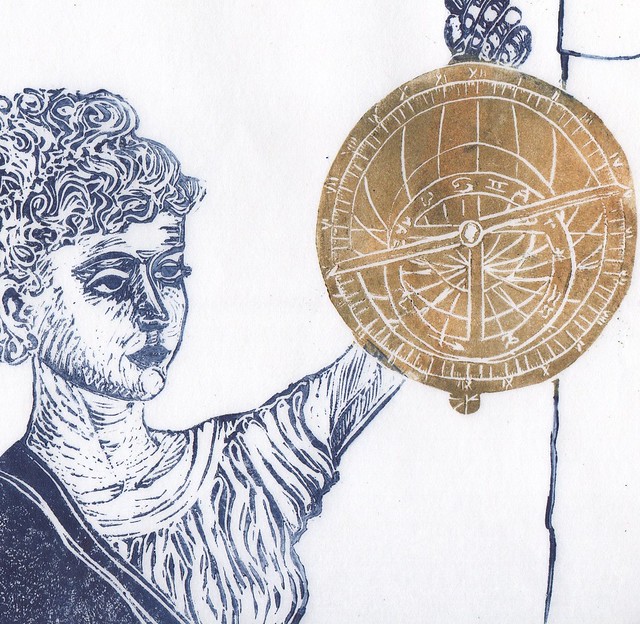
Hypatia studied astrology, astronomy and mathematics. She was later credited by her
students of inventing the astrolabe. However this is very unlikely because the astrolabe was
dated a few centuries earlier. Historians believe she merely promoted the astrolabe’s use. In
addition, she studied conic sections, which were introduced by Apollonius. She wrote a book
called On the Conics of Apollonius. She was credited introducing ideas of ellipses, hyperbolas,
and parabolas.
Hypatia with Astrolabe (the astrolabe
was used by astronomers, navigators, and astrologers, to find the time, place, and
positions of constellations in the sky)
At the end of the antique period, Christianity was starting to dominate the roman religion.
Riots frequently broke out between the different religious sects. Two leaders were opposing
each other, Cyril and Orestes. Hypatia, who happened to be a good friend of Orestes, was
unfortunately involved. Cyril spread nasty rumors about her. In 415 AD, a violent mob attacked
Hypatia on her way home. They apparently stripped her and killed her with shards of pottery,
then dragged her through the streets.
At this time Hypatia was one of many persecuted by the Christians, because she was
pagan. The Christians persecuted the pagans persecuted as much as the pagans persecuted them.
However not all Christians did this. Some were ambivalent and did not care. This example shows
how the Christians behaved when the tables were turned on the pagans.
Bibliography:
http://www-groups.dcs.st-and.ac.uk/history/Mathematicians/Hypatia.html
http://www.agnesscott.edu/lriddle/women/hypatia.htm
http://www.astr.ua.edu/4000WS/HYPATIA.html
http://www.heretication.info/_pagans.html
to be a well-known and respected philosopher and scientist throughout Egypt. Some historians
believe that Theon wanted to raise the perfect human. It is apparent that she had developed a
passion for mathematics and sciences. Most historians are certain that Hypatia surpassed Theon’s
knowledge at a young age. Her father also taught her the fundamentals of teaching so that she
became a very enticing orator.
Hypatia studied astrology, astronomy and mathematics. She was later credited by her
students of inventing the astrolabe. However this is very unlikely because the astrolabe was
dated a few centuries earlier. Historians believe she merely promoted the astrolabe’s use. In
addition, she studied conic sections, which were introduced by Apollonius. She wrote a book
called On the Conics of Apollonius. She was credited introducing ideas of ellipses, hyperbolas,
and parabolas.
Hypatia with Astrolabe (the astrolabe
was used by astronomers, navigators, and astrologers, to find the time, place, and
positions of constellations in the sky)
Riots frequently broke out between the different religious sects. Two leaders were opposing
each other, Cyril and Orestes. Hypatia, who happened to be a good friend of Orestes, was
unfortunately involved. Cyril spread nasty rumors about her. In 415 AD, a violent mob attacked
Hypatia on her way home. They apparently stripped her and killed her with shards of pottery,
then dragged her through the streets.
At this time Hypatia was one of many persecuted by the Christians, because she was
pagan. The Christians persecuted the pagans persecuted as much as the pagans persecuted them.
However not all Christians did this. Some were ambivalent and did not care. This example shows
how the Christians behaved when the tables were turned on the pagans.
Bibliography:
http://www-groups.dcs.st-and.ac.uk/history/Mathematicians/Hypatia.html
http://www.agnesscott.edu/lriddle/women/hypatia.htm
http://www.astr.ua.edu/4000WS/HYPATIA.html
http://www.heretication.info/_pagans.html
Romanization of British Religion
Owen K-W
Latin 3
5/23/14
The Romanization of British Religion
When the Romans started moving into Britain, many aspects of ancient British culture were changed and merged into Roman culture as Britons became citizens or Rome. According to the British Museum, following the Roman religion was necessary to prove loyalty to Rome. However, the not all of the Britons necessarily wanted to convert to another religion. The Romans, to make the foreign religions easier to understand, associated certain British deities with their own, which as a side effect made it more simple for the British people to worship their own gods but still be loyal to Rome. An example of this is the town of Bath, there the goddess Sul was worshiped. According to AQUAE SULIS, Sul was the goddess of rivers and fertility, as well as being a mother goddess. When the Romans arrived at Bath, they associated Sul with Minerva because they were both thought to have healing powers. The British religion was greatly changed by the Romans, but it kept many significant traits, such as the importance of sources of water and the number three. There were several Romano-british trios of gods and goddesses, according Rhythms of Triplism: The Triple Figures of Romano-Celtic Sculpture. While the Romans generally had no problems with British religion, they had very serious conflicts with the druids, who the Romans were afraid would contest their leadership. Several laws were passed prohibiting their religious rituals, and emperor Augustus did not allow people to be both Roman citizens and druids at once.
As the Romans moved in to Britain, their culture became mixed with the culture of the British. Many British gods were similar enough to one of the Roman gods that the two were blended into one. Rome's religion was somewhat flexible, making it simpler for Rome to take over areas with different deities. However, when a religious group proved to be a threat, Rome did not hesitate to take it down.
Bibliography
http://www.unc.edu/celtic/catalogue/triplism/
Monday, May 26, 2014
Raphael Human Sacrifice
Raphael Kahn
Latin 3, Period 7
5/26/14
Roman
Sacrificing
Roman sacrifices were held so that Romans could repay the
spirits that they had invoked. For instance, in order to repay Mother Earth for
harvesting crops, the Romans held the annual spring festival of the Fordicidia. In this festival, they would
kill a pregnant cow and make a burnt sacrifice of her aborted calf, in order to
transfer the cow’s fertility to the earth. Sacrifices could also be used to
symbolize the transfer of ownership. The typical sacrifice was performed
through four phases: the praefatio,
the immolatio, the slaughtering, and
the banquet. In the praefatio, after
the purification of the participants and victims, a procession led them to the altar
of sacrificing. In the immolatio,
wine was poured on the victim’s face and salted flour was sprinkled on the
victims back. In the slaughtering, the victim was killed, butchered, and had
its corpse opened up for the inspection of its vital organs. If the quality of
the organs were deemed unsatisfactory, the sacrifice was held again. In the
banquet, the victim was beheaded and the vital organs were set aside and
prepared for offering. The method of preparation depended on what type of
animal the victim was. After the vital organs were prepared, they were offered
to the deity for whom the sacrifice had been conducted for. The manner of
offering depended on which deity it was. For example, the offerings were thrown
into the water for an aquatic deity. After the offerings were given to the
deity, the rest if the victim was prepared for human consumption. While Romans
were perfectly content to sacrifice all manner of creatures, fruits, vegetables,
and even inanimate objects such as necklaces and bracelets, they abhorred human
sacrifice. The Roman government did not tolerate human sacrifice, and by extension,
did not tolerate Gaulish Druids. In Pliny the Elder’s writing, he denounces the
nature of the Druids as barbaric for their belied in human sacrificing.
While some people may have deemed the ancient Romans as
barbaric for their conquering, slavery, and sacrificing, they did hold high
standards for their time. They allowed more freedom of religion then was
expected for their time period, they allowed slaves to earn their freedom, and
they abhorred and outlawed human sacrificing. There is even a story about a man
who, in order to please the gods, sacrificed his son. To do this, he killed his
son, mutilated him, made him into a soup, and served it to the gods. Jupiter,
finding this disgusting, sent the man to the underworld as punishment and
reanimated the son. Yes, the ancient Romans had some questionable customs, but
hey-at least they were not Druids.
Sources:
- The Oxford Companion to Classical Civilization edited by Simon Hornblower and Anthony Spawforth
- A History of the Roman People by Allen M. Ward, Fritz M. Heichelheim, and Cedric A. Yeo
- Google images
Sunday, May 25, 2014
Curses
During the start of
the 1st Century A.D., there were Romans who had very
unique ideas about how religion worked. They believed that people
could pray to their gods, to improve their own lives, and to ruin
others. Many people would wonder why others would want to cause
others harm.
In recent years,
archeologists have discovered several tablets where ancient Roman
civilization used to dwell. Some of the tablets are made of lead, and
others are made from pewter, with inscriptions carved into them,
asking for a god to grant the writer's the suffering of another
individual. These tablets, are called “defixiones,” or, “curse
tablets.” A few hundred have been excavated in Britain alone, and
approximately ninety have been dug up in the historic town of Aquae
Sulis.
The procedure of
creating a curse tablet could follow a couple of methods. The first
step, was to identify the intended recipient of the tablet-maker's
wrath, and then inscribe it on the tablet. If the owner did not know
the name of the victim, than they'd write an inventory of potential
names instead. The next step was to explain the crime committed
against the tablet's creator. Finally, they would identify the deity
they wanted to do the act, and provide a description of how to go
about the punishment, which would usually be very detailed, and very
gory. Upon completion, the tablet would be rolled up, and either
attached to a tomb, or dropped down a well.
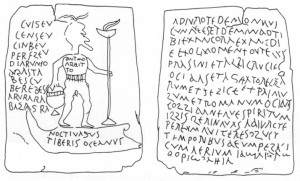
Sometimes the
tablet might have been more elaborate than just mere words. Some
people had an idea that if written backwards, the words of the curse
would have greater effects. Another idea for augmenting the potency
of the tablet involved nonsensical words that did not exist. These
included, “bazarga; bescue; berebescue; phrix; phrox;” and even,
“abracadabra.” Some even included illustrations depicting demons
or other mythological figures. In today's society, there would be
many people who would disagree with this belief, given that it shows
such malice towards others.
It is fascinating
that the Romans, “... tended to see their gods as possible allies
in the struggles of life.” (Cambridge, Page 42). However, there are
some people who would disagree with the way the Romans applied the
boon of divine alliance to the expense of another person, there are
others who would promote the belief of a higher power looking out for
individuals happiness and well-being.
Bibliography:
Cambridge Latin III
Saturday, May 24, 2014
Persecution of Christianity
The Roman Empire is remembered today for its awesome power and many innovations, but one aspect of their remembrance has become a prominent discussion in our day and age, the prosecutions of Christianity. To an extent, Romans were understanding in others’ religions and cults. One of the major parameters they did set was that these groups had to pray to their gods. After Jerusalem was captured, Jews were treated harshly by the Romans, in part by their unwillingness to recognize Roman gods and the emperor as holy. There was tension on both sides but over time and integration between Jews and Romans, Jews were allowed to practice their religion without objection. Romans understood they were passionate about their belief in a singular god and could see the reasoning behind not preying to anyone else. However when Christianity came along, the Romans did not want to make another exception for a similar religion. After all, the Old testament for Christianity is the Torah for Judaism. In 64 C.E., Emperor Nero engineered the first attack on Christianity. He blamed the Great Fire, which some had thought he ordered, on those of Christian faith. During specific negative events or times of crisis, persecutions took place to take out the Romans’ anger and to use as a distraction. It was common for emperors to order persecutions to take the focuses off their negativity. These persecutions were accomplished in different ways. One of the most common methods was burning Christians alive, but there were other methods like putting Christians in a beast-fighting ring or feeding them to dogs. Throughout the first, second, and third centuries, persecutions severely depended on how the local governments approached Christianity. Often times persecuting Christians just became scapegoating for another issue. The fact that they were Christan were attacked making other important issues in less significant. On a broad point, Christians were prosecuted to discourage further conversions and bring people back to the belief in the Roman gods. This is how the last persecution of Christianity began. Galerius, the ruler of one of the four Roman provinces, convinced another named Diocletain to start persecuting in order to restore the purity in Roman religion that was severed by the introduction of Christianity. From the year 303 to 313, Christians had to swear an oath to the Roman gods and make an offering to them or die. During this time, churches were burnt, Christians were imprisoned, tortured, and murdered in one of the largest persecutions in Roman history. The persecutions of Christianity have extreme importance for they led, in part, to the rise of the Christianly. Although Christianity had already gained a following prior to the persecutions, the persecutions drew attention to the cause. If someone demands someone can not do something, the instinct reaction is to do exactly that. The Roman persecutions of Christianity had an drastic influence in the world we see today.
Works Cited
Websites:
http://www.fourthcentury.com/notwppages/persecution-timeline.htm ( Supported by History Department of Wisconsin Lutheran College and by Asia Lutheran Seminary)
http://www.britannica.com/EBchecked/topic/164042/Diocletian/1832/Persecution-of-Christians
Books:
Friday, May 23, 2014
Cult of Mithras
Zachary Emil
Ms. Hatmaker
Latin III/Period 7
5/21/2014
Cult of Mithras
The Cult of Mithras, otherwise known as Mithraism or the Sun religion, was a religion that most originated from Persian Zoroastrianism, but officially recognized as a cult by the Roman Empire. They worshiped Mithra, a god commonly associated with light or the sun, and a hero of lightness over darkness. Mithraism is often referred to as a "mystery cult," secrecy played a large role in the religion. No written texts from Mithraism exist, and rituals were practiced in temples, known as Mithraeum, disguised to look like natural caves. What is known of the mythology is from paintings and reliefs in these temples; two of the most common depict Mithras sacrificing a sacred bull, and Mithras being born from a rock. Sol, the personified god of the sun, is often depicted alongside Mithras. Those who joined Mithraism had to sacrifice a bull, and were baptized in its blood. There was also a class system: Corax, Nymphus, Miles, Leo, Perses, Heliodromus, and Pater. Those who gained the title of Pater, or father, were allowed to be head of the congregation. It was very popular among Roman soldiers, most likely because of Mithras reputation of a warrior for good, as well as those who weren't citizens of Rome, such as merchants. However, women could not join. Mithraism began to grow in power and in followers; at one point, there were several Roman senators were suspected to be part of the Cult of Mithras. Its eventual downfall is commonly attributed to the spread of Christianity after it was named the Roman Empires official religion by Constantine, as well as the fact that it restricted its followers more.
Bibliography:
A history of the Roman People, edited by Allen ward and fritz heichelheim and Cedric Yeo
Subscribe to:
Posts (Atom)